

Hi, horror fans. We’re looking at a bloody slice of horror film history today, and I hope it interests you, as it deals with British Horror Cinema (one of my favorite topics), and its fascinating evolution.
In my opinion, British horror cinema, while popular, has received little critical attention outside of the Hammer Horror films. This post aims to explore British horror in the context of censorship, its treatment by critics, and its consumption by fans. I’ll also attempt to examine the ‘Britishness’ of British horror and sub-genres such as psycho-thrillers and witchcraft movies, as well as some of our favorite key filmmakers. But first, some context.
Historical Context
The British Board of Film Censors (BBFC) has had a strained relationship with horror cinema since the early 20th century.
- In 1920, the BBFC considered banning The Cabinet of Dr. Caligari (1920) due to concerns about distressing asylum scenes.
- In 1922, Nosferatu was banned, possibly to appease Bram Stoker’s widow.
During World War II, horror film distribution was suppressed. In 1951, the ‘X’ rating was introduced, but it continued to treat adults like advanced children, negatively impacting the horror genre.


Censors vs. Horror
Horror cinema focuses on the fluctuating boundaries of taboo and relies on transgression, which presents a problem for censors. The British censors’ approach has been to neutralize horror movies, blunting their impact. More inventive horror movies are often butchered or banned.
Enter the infamous John Trevelyan, a former censor, who reflected the view that genuinely scary movies were inherently vile. He cut scenes from films like Horrors of the Black Museum (1959) to reduce their power over the audience. Trevelyan seemed to inanely believe that horror films should be silly rather than scary. Also, in 1961, the Board banned Mario Bava’s Black Sunday (1961) but strangely allowed it to play freely under a different title later on, which seems to me utterly ridiculous.


But what about our beloved Hammer Films? Well, the censors were relatively tolerant of Hammer because Hammer agreed to avoid mixing sex with horror and overly gory scenes. In spite of this, they still managed to get away with a lot of shock and terror – lucky us!
Landmark Cases
- Witchfinder General (1968): Heavily censored despite the director’s condemnation of the atrocities portrayed. Michael Reeves withdrew from the re-editing process.
- Last House on the Left (1972): Refused a theatrical certificate in 1974.
- The Texas Chain Saw Massacre (1974): The BBFC refused to certificate it, deeming it had an awful impact all the way through.

The Video Nasty Era
The rise of unregulated videotapes in the early 1980s led to the release of movies that the BBFC would not pass for theatrical distribution. Tabloid newspapers mounted a campaign against these “video nasties,” blaming them for various social problems.
The “video nasties” era was therefore a period of heightened censorship and media-fueled moral panic in Britain, sparked by the rise of these unregulated videotapes.

Key aspects of this era:
- Unregulated Video Market: Spotting a business opportunity, some entrepreneurs released movies on video that the BBFC would not pass for theatrical distribution, including titles such as The Driller Killer (1980), Cannibal Holocaust (1979), SS Experiment Camp (1976), and I Spit On Your Grave (1981).
- Media Hysteria: As mentioned in the intro, tabloid newspapers launched a campaign against the new “threat” of “video nasties,” which they blamed for various social problems.
- Government Action: Following a Conservative election victory, the government passed the Video Recordings Act (VRA) in 1984. This empowered the BBFC to classify and cut all video releases, with special regard to the likelihood of videos being viewed in the home.
- Increased Censorship: The VRA’s emphasis on home viewing led to stricter censorship of videos compared to their cinematic counterparts. An average of one in four “18”-rated videos were cut by the BBFC.
- Prosecutions and Banning: Between 1983 and 1985, the Director of Public Prosecutions created a list of around sixty titles considered prosecutable under the Obscene Publications Act (OPA). Many films were removed from British video shelves, with fines for those who transgressed. The Evil Dead, even after cuts, remained banned until 1990.
- The James Bulger Case: Further damage was done to the reputation of horror movies in the UK in 1993–4 by the press coverage surrounding the conviction of two boys for the murder of James Bulger. The media linked the crime to an alleged viewing of Child’s Play III (1991).
- BBFC Response In response to moral panic, the BBFC was legally required to consider potential harm caused by criminal, violent, horrific, or sexual behavior in videos.


In 1984, the government passed the Video Recordings Act (VRA), empowering the BBFC to classify and cut video releases. This act led to more stringent censorship of horror videos. The Evil Dead, for instance, was prosecuted in the early 1980s and was finally passed at “18” only after many many cuts. Horrifying!
Contemporary Challenges
In 1993–94, press coverage of the James Bulger murder led to increased censorship. An amendment to the Video Recordings Act legally required the BBFC to consider potential harm caused by criminal, violent, horrific, or sexual behavior in videos.
Critical Reception
British critics from the late 1950s to the early 1970s attacked British horror films in ways similar to those used against Gothic novels. This critical discourse damaged horror cinema in Britain. Some recurring themes include:
- Films being judged by inappropriate standards.
- Criticism for explicit depiction of physical details.
- Disturbance when directors are not sufficiently “distanced” from the material.
Critical disdain for horror films meant that no mainstream critic defended any of the “video nasties” in print.

The State of British Horror
British horror films were, for a long time, overlooked by both academic critics and mainstream audiences, particularly during the 1980s and 1990s. This period was marked by the fallout from the “video nasties” moral panic of the early 1980s, which led to strident censorship campaigns and a highly restrictive environment for filmmakers. The British Board of Film Classification (BBFC) imposed bans or heavy cuts on many horror films, discouraging producers from investing in the genre. As a result, much of the output during this time consisted of low-budget productions that struggled to gain visibility or critical recognition.
Despite these challenges, British horror persisted in various forms. A number of horror or horror-adjacent films were produced during the 1980s and 1990s, though they often flew under the radar. However, this era also laid the groundwork for the genre’s eventual resurgence. By the late 1990s and early 2000s, British horror began to reassert itself on the global stage with innovative and genre-defying films. Titles like Shaun of the Dead (2004), The Descent (2005), and 28 Days Later (2002) not only achieved box office success but also demonstrated that British filmmakers could bring fresh perspectives to horror, blending social commentary with visceral storytelling.


In recent years, British horror has gained significant academic attention. Scholars have increasingly recognized its unique contributions to global cinema, exploring themes such as class conflict, urban decay, and national identity. Books like Contemporary British Horror Cinema by Johnny Walker (2020) and The Modern British Horror Film by Steven Gerrard (2018) highlight how the genre has evolved into a rich field of cultural and cinematic study. Far from being invisible, British horror is now celebrated as a dynamic and influential part of both film history and contemporary cinema.
British Horror Today
The landscape of British horror today is vastly different from its troubled past. The BBFC has significantly relaxed its stance on censorship compared to the draconian measures of the 1980s. Many films that were once banned or heavily edited—such as The Texas Chain Saw Massacre—are now available uncut in the UK. This shift reflects a broader cultural change: audiences are now seen as capable of distinguishing between fictional violence and real-world harm. While the BBFC still enforces strict guidelines for extreme content, particularly where child protection laws are concerned, it has adopted a more nuanced approach to classification.

This more permissive environment has allowed British filmmakers to explore darker and more provocative themes without fear of excessive censorship. The genre has also diversified in terms of style and subject matter. Contemporary British horror often moves beyond traditional gothic tropes to address pressing social issues. For example:
- Films like Eden Lake (2008) and The Children (2008) explore anxieties about youth violence and societal breakdown.
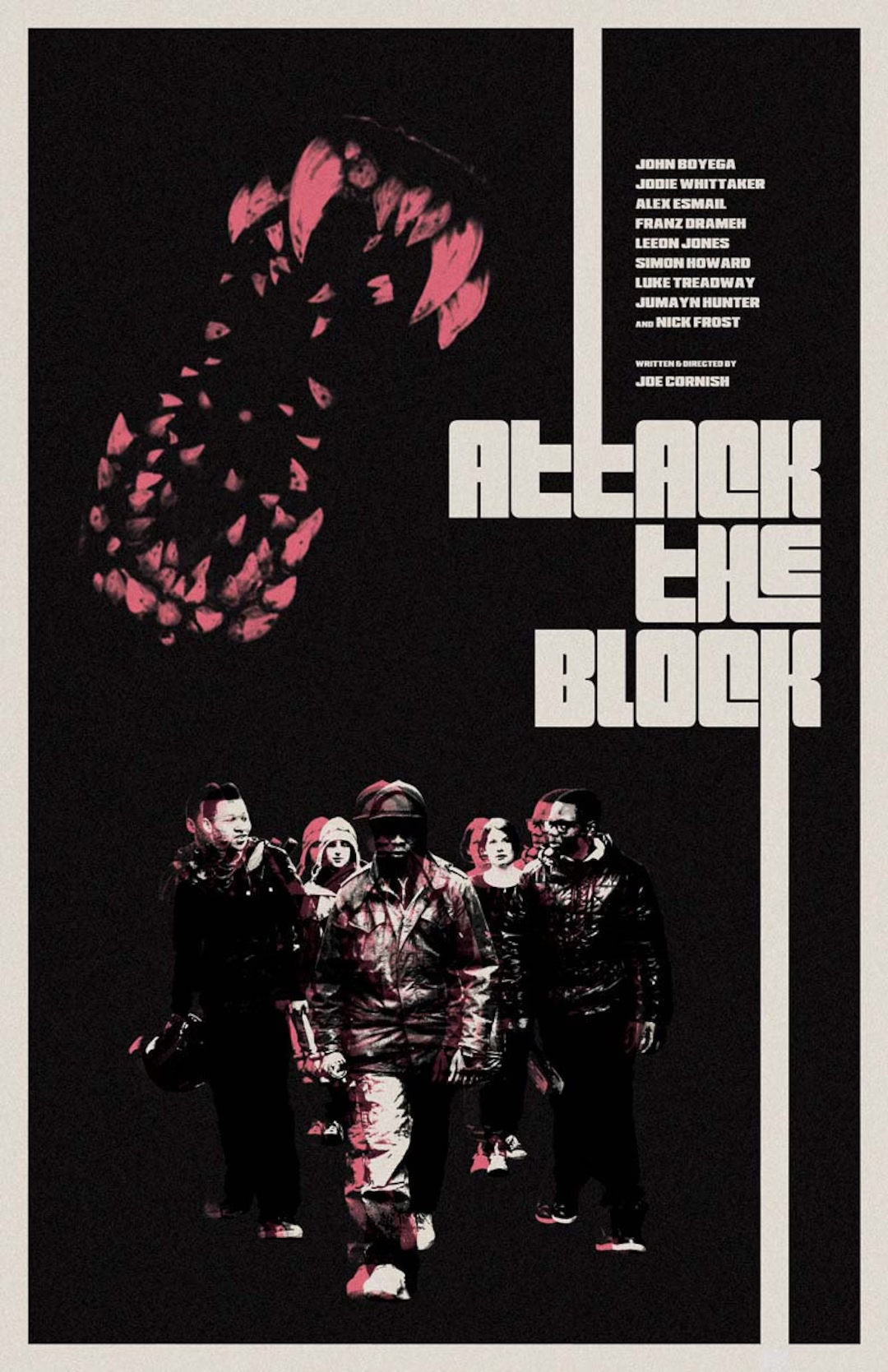
- Attack the Block (2011) combines science fiction with urban horror to comment on class inequality and inner-city life.
- Folk horror has experienced a revival with films like A Field in England (2013) and In the Earth (2021), which draw on rural settings and pagan themes to create unsettling narratives.
This renaissance is not limited to domestic audiences; British horror has found a global audience thanks to streaming platforms and international film festivals. Filmmakers like Ben Wheatley (Kill List, Sightseers) and Peter Strickland (Berberian Sound Studio, In Fabric) have gained critical acclaim for their distinctive approaches to the genre.


Moreover, academic interest in British horror continues to grow. Scholars are increasingly examining how these films reflect broader societal concerns, from economic inequality to political instability. This intellectual engagement has helped elevate the genre’s status, ensuring that it is no longer dismissed as mere schlock or exploitation.
In short, British horror today is thriving creatively, commercially, and critically. It stands as a testament to the resilience of filmmakers who have turned past adversities into opportunities for innovation. With its rich history and dynamic present, British horror remains a vital part of global cinema.
The Wrap-Up
The history of British horror cinema is inextricably linked with the evolving landscape of film censorship in the UK. From the early days of the BBFC to the video nasty era and beyond, horror filmmakers have consistently pushed boundaries, challenging societal norms and censors alike. This ongoing tension has both hindered and shaped the genre, resulting in a unique brand of British horror that often relies on subtlety, atmosphere, and psychological terror rather than explicit gore.
Despite facing significant obstacles, including stringent censorship, critical disdain, and periods of suppression, British horror cinema has demonstrated remarkable resilience. It has produced iconic films, influenced global horror trends, and maintained a dedicated fan base. The genre’s ability to adapt and evolve in response to changing societal attitudes and censorship regulations speaks to its enduring appeal and cultural significance.

The relationship between British horror cinema and censorship continues to evolve. While some classic horror films are have been released uncut, the legacy of past censorship still influences both filmmakers and regulators. The challenge for the British horror genre moving forward will be to navigate this complex landscape, balancing creative expression with societal concerns, while continuing to produce innovative and thought-provoking films that resonate with audiences.
Ultimately, the story of British horror cinema and censorship serves as a fascinating case study in the interplay between art, society, and regulation. It shows us that horror, at its best, does more than simply shock or frighten – it reflects our deepest terrors, challenges our preconceptions, and pushes us to confront the boundaries of what we consider acceptable in art and entertainment.
Do you have any thoughts on the state of British Horror Cinema, horror fiends and friends? If you do, leave some comments below, and we’ll start a discussion.

Article Info
- Thanks for reading, Fear Friends! If you want to revisit, save, highlight, and recall this article, we recommend you try out READWISE, our favorite reading management and knowledge retention app. All readers of The Longbox of Darkness automatically get a 60-day free trial.
- This post contains affiliate links. Purchasing through them will help support darklongbox.com at no extra cost to our readers. For more information, read our affiliate policy.
Discover more from Longbox of Darkness
Subscribe to get the latest posts sent to your email.